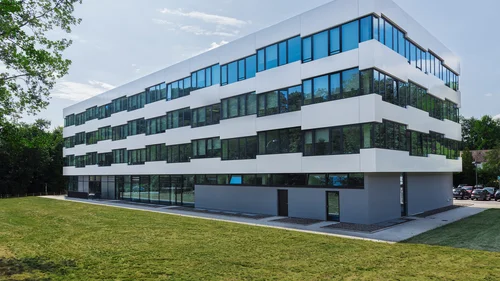
The CISPA Helmholtz Center for Information Security is a German national Big Science Institution within the Helmholtz Association. Its research agenda encompasses all aspects of Information Security.
As a Helmholtz Center for Information Security, we are dedicated to cutting-edge foundational research combined with innovative application-oriented research in the areas of cybersecurity, privacy, and artificial intelligence.
Stay informed about the latest breakthroughs, publications, and innovations from our research teams. Explore our original insights, research articles, and press releases, and don’t miss out on upcoming events and conferences.
We at CISPA strive to offer scientists, along with their partners and families a pleasant and friendly living environment. This means that at our research center, all of us are on first-name terms.
Transferring our research into applications and products is one of CISPA's core tasks. In this way, we ensure that the economy and society at large can benefit from pioneering innovations, state-of-the-art technologies and our latest research findings.
At CISPA, we organize and participate in a variety of knowledge transfer activities. They range from public events and trade fairs to policy consultation and citizens' dialogues.
NEWS ARCHIVE
All
Research
Report
Press Release
Interview
Podcast
Event
Announcement
Conference
CISPA researcher Michel Meintz from the SprintML Lab investigated whether watermarks survive the training of a new generative model.
Dhekra Mahmoud has been recognized by the “L'Oréal-UNESCO For Women in Science – Young Talents France” program.
We warmly welcome our new CISPA-Faculty.
Mathematically guaranteeing the security of our computations is the goal of Dr. Pierre Meyer, who joined CISPA from Aarhus University in July.
Franziska Boenisch and Adam Kortylewski are taking on new professional challenges. In an interview, they reflect on their time at CISPA.
From its beginnings in 2011 to becoming a Helmholtz Center, Michael Backes played a defining role in CISPA’s development.
Founding Director Leaves CISPA.
Samira Abedini is researching how individual AI agents can influence the decisions of an entire group.
CISPA researcher Matteo Leonelli introduces THEMIS, a new fuzzing framework designed to uncover security vulnerabilities in WordPress plugins.