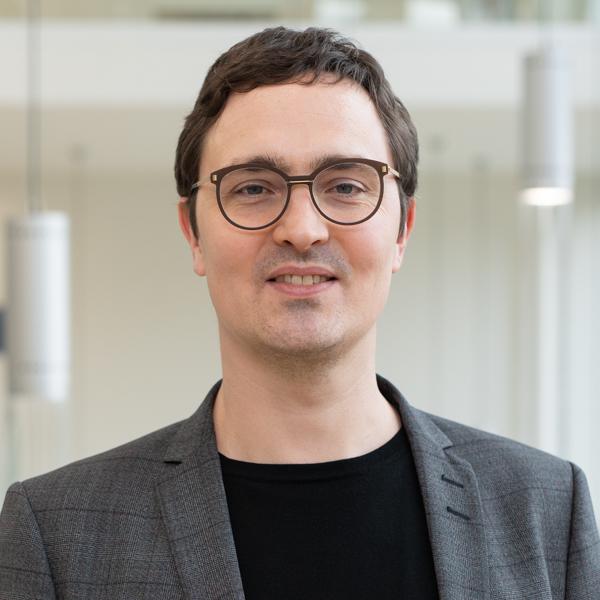
Faculty
Mario Fritz ist Faculty am CISPA Helmholtz-Zentrum für Informationssicherheit, Honorarprofessor an der Universität des Saarlandes und Fellow des European Laboratory for Learning and Intelligent Systems (ELLIS).
Bis 2018 leitete er eine Forschungsgruppe am Max-Planck-Institut für Informatik.
Zuvor war er PostDoc am International Computer Science Institute (ICSI) und an der UC Berkeley, nachdem er an der TU Darmstadt promoviert und an der FAU Erlangen-Nürnberg Informatik studiert hatte.
Derzeit koordiniert und leitet er unter anderem das von der EU geförderte Exzellenznetzwerk „ELSA – European Lighthouse on Secure and Safe AI“.
Sein Forschungsschwerpunkt liegt auf vertrauenswürdiger künstlicher Intelligenz, insbesondere an der Schnittstelle von Informationssicherheit und maschinellem Lernen.
Science Robotics How foundation models will revolutionize robot swarms
Conference of the European Chapter of the Association for Computational Linguistic (EACL)
Funny or Persuasive, but Not Both: Evaluating Fine-Grained Multi-Concept Control in LLMs
IEEE Access An Exploratory Survey Study Toward a Conceptual Framework for Structuring the Integration of Privacy-Enhancing Technologies in Federated Learning and Analytics
Winter Conference on Applications of Computer Vision (WACV)
Deepfake Detection that Generalizes Across Benchmarks
CoRR Certified Circuits: Stability Guarantees for Mechanistic Circuits.
Science The science and practice of proportionality in AI risk evaluations
NeurIPS-Workshop (NeurIPS-W)
Justice in Judgment: Unveiling (Hidden) Bias in LLM-Assisted Peer Reviews
NeurIPS-Workshop (NeurIPS-W)
Beyond Steering: Evaluating Fine-Grained and Multi-Concept Control in LLMs Proceedings Article
NeurIPS-Workshop (NeurIPS-W)
Can LLMs Propose Instrumental Variables for Causal Reasoning?
Conference on Neural Information Processing Systems (NeurIPS)
MaxSup: Overcoming Representation Collapse in Label Smoothing